
Notes from the shearing shed
Entry No. 001
Thank you for being here
On the motorcycle ride back to Montana after alpaca shearing from San Diego to Paso Robles. I reflected on our shearing journey as recent memories unfolded and old memories surface and riff off the new ones, changing and moving like the temperatures as you ride through, the different smells and surfaces, and hear the blast of the v-twin motor propelling you along the highway. Like a dream, my thoughts unfolded as I chased them with voice memos or notes in my journal at gas stations. That’s how this journal for Ember Heritage was born. Notes From the Shearing Shed.
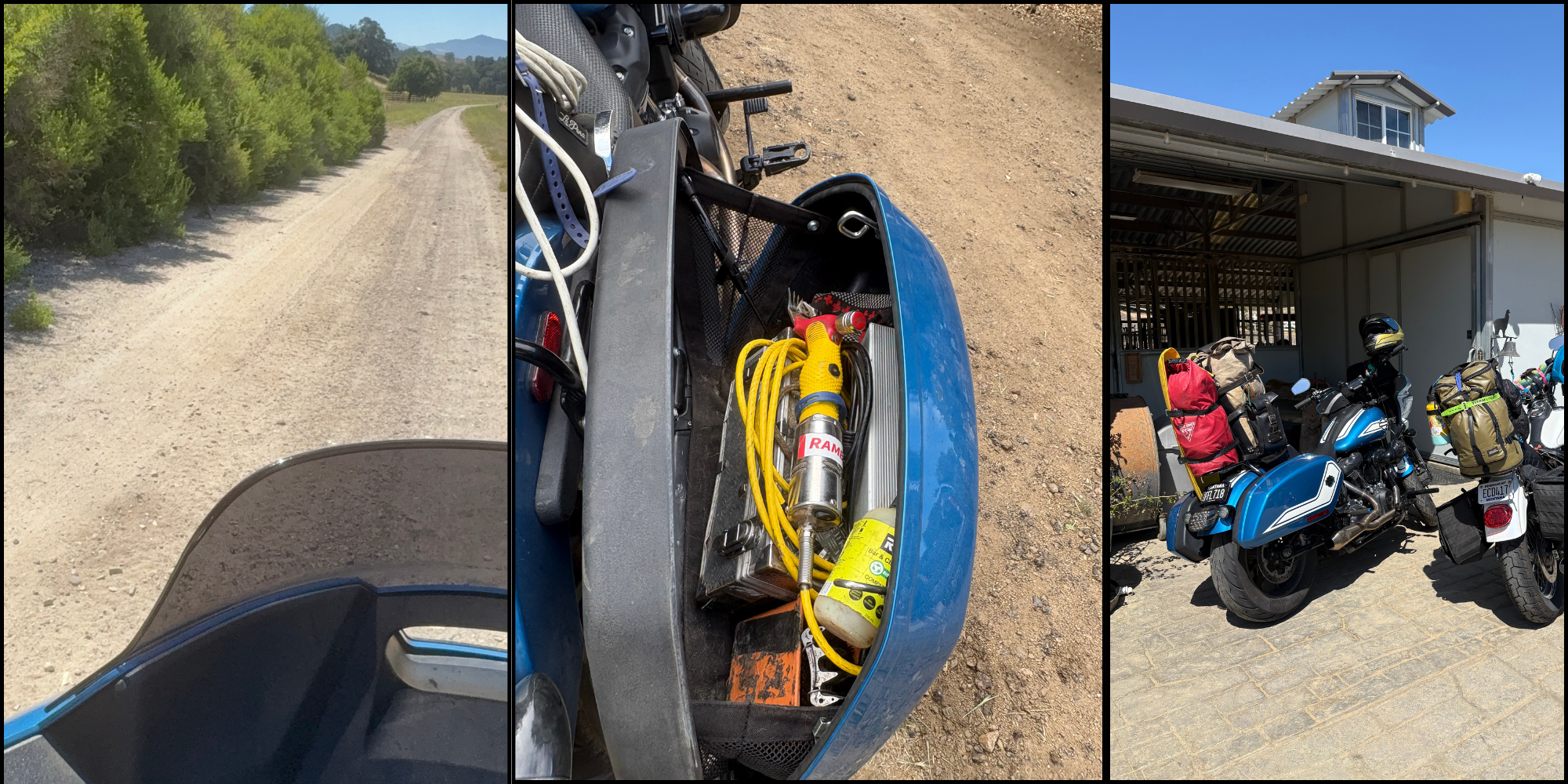
2026 is my 21st year shearing alpacas.
My first time shearing alpacas was shearing with David Carrell from Monroe, Georgia in Sandy, Utah at the National Alpaca show in 2005. We were there to shear the alpacas for transport back home after they show. There was another shearer there but he had his crew so I worked with David.
The first animal we sheared I asked him:
“Hey what do I do? Do I hold the animal like how those other guys were shearing?”
“No. Those guys don't know what they are doing.” He said in a thick southern Forest Gump like accent with a smile. “Just follow me and keep your hands out of the shears and hold the ears and I'll tell you what to do...”
David turned the handpiece on and just like that we were shearing.
Our Tools
Our tools are simple. For alpaca shearing, we use a custom set of ropes made in house using climbing ropes, climbing carabiners, custom hobbles and a fiddle cam used for sailing, as well as the electric shearing handpiece and our blades. These consist of a set of different sized blades; the blade on the bottom is called a comb because it has comb-like teeth and uses a combing motion to glide upon the animal's skin as the other blade, called a cutter, moves quickly back and forth across the comb cutting the fiber as we smoothly push the electric handpiece across the animals contours. Deliberately and efficiently we work to get as close to the skin as possible leaving the fiber with a uniform length for the mill. This combination: tool, man, and animal goes back at least 5000 years.
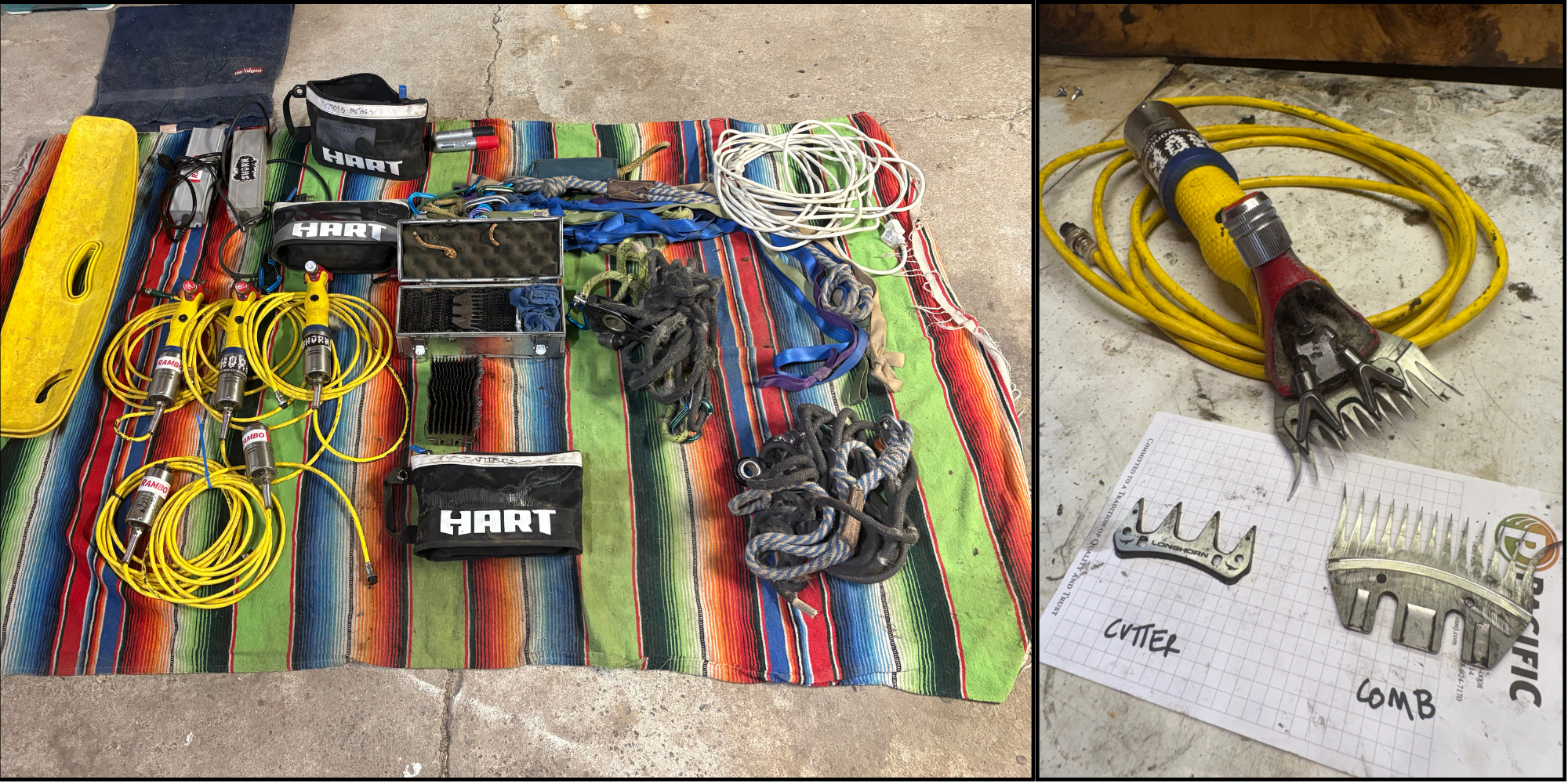
I like to compare shearing to the Japanese calligraphy art Shodo wherein the artist's tools are a brush, ink, and paper. Similar to shearing, very simple straight forward tools that contain a lifetime's worth of nuance and understanding. Any person can look at the simplicity of the tools and the artist's simple execution within their medium and think ‘wow that's easy’, as anyone practiced and skilled in their craft makes that craft look easy. The better you are the easier you make it look.
I identify specifically the Sosho style of Shodo where the artist engages in a highly cursive and abstract, flowing script where characters are drastically simplified into continuous and expressive lines. I think of our long broad blows across an alpaca or bison as the simple, continuous and expressive lines. We move in crisp clean gestures with long full strokes here and short nuanced blows there, keeping the shearing handpiece level and moving steady through the fiber like an artist's brush. With a clear mind and understanding of our machine’s rhythm and the sharpness of our blades, we glide through an alpaca from start to finish in 4 minutes. We finish, shut off the machine, release the animal with gratitude and begin the process again. Just like the calligraphy artist we paint the same character 100 times a day- all the same and all different... at the same time.
The Journey
Over the last 21 years the same simple combination of blades and the shearing handpiece have been my medium. They have taken me all over the USA, Australia, and New Zealand, and Peru. I have had the opportunity to work with professional wool classers, had dinner with international wool brokers, sheared for celebrities, worked with fiber mills in the US, Canada, OZ, and Peru. I have been able to meet and work with many of the people that make the international wool/alpaca fiber industry the international tapestry it is today. I have been able to see the construction of heritage textile brands, to witness people with dreams of changing the wool industry act on those dreams and succeed in changing the industry and also how people see wool.
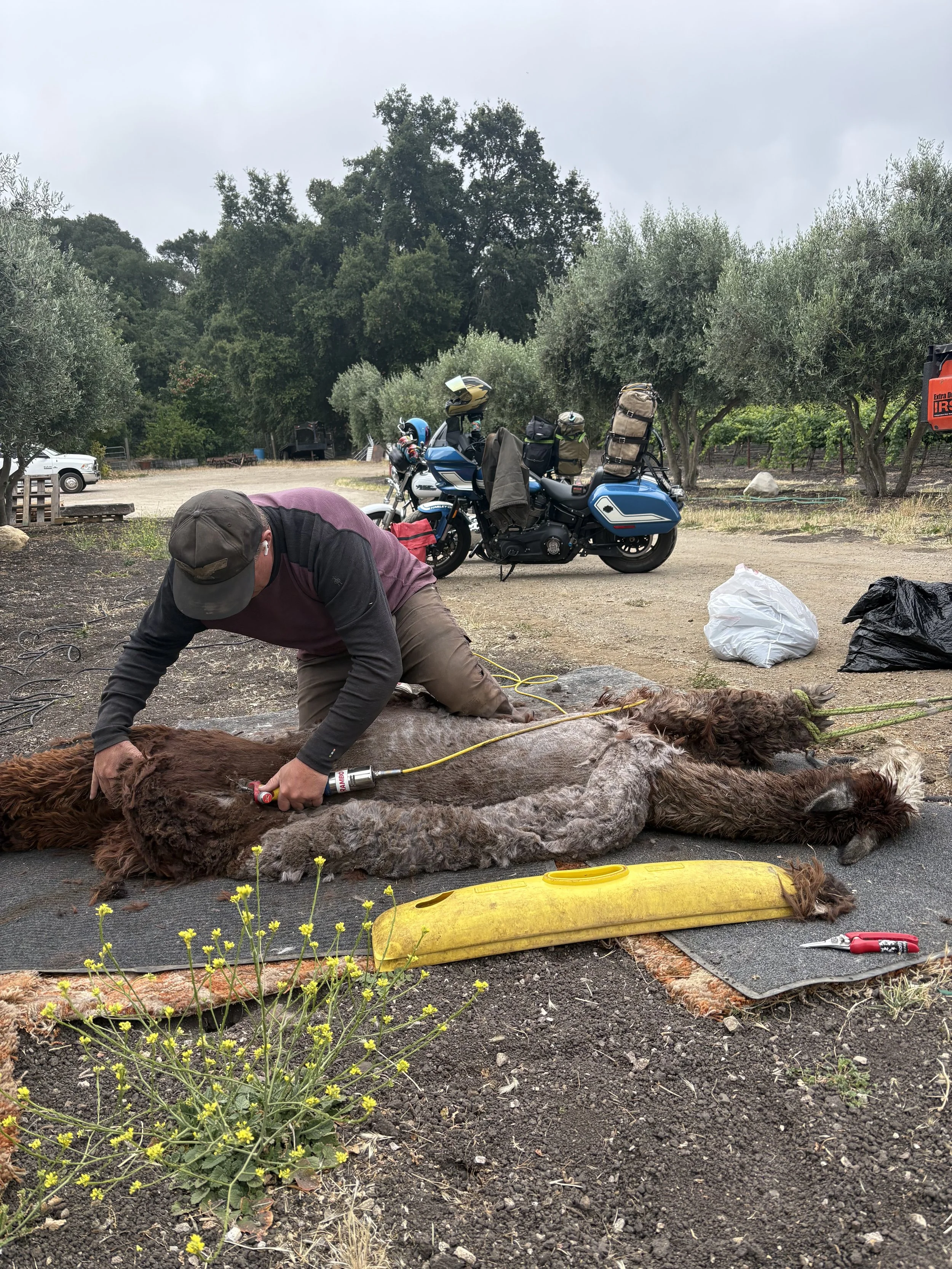
Skilled shearing and understanding of the fiber is the foundation for any natural fiber textile- alpaca, vicuna, wool, and bison.
If the shearing is not done correctly then every process after is compromised and you end up with a product that is not as good as it could be.
It is through the simple lens of shearing and understanding the fundamentals of natural fiber that we launched Ember Heritage. We are on a journey creating something that in 20 years people will read our journals and put on one of our JacShirts and understand they were and are still a part of something. Our heritage garments reveal the poetry in the passage of time and we are making them right now.
Our Ember Heritage pieces are built to last with an understanding of the past... a nod to those that have come before us and a High-5 to those that come after us.
As we crossed state line after state line and blasted through the heat mile after mile, I thought about the Harley Davidson I was riding, a modern machine with ideas and designs from the past, a true american heritage piece built to last and made for the open road.
With Ember Heritage we are adding to the American tapestry with our passion, vision, and hearts and we welcome to the Shearing Shed, and Thank you for being a part of the journey!
All the Best,
Pete
—————-
Around the Workshop…
